
The experience of living with adult ADHD can make work, one’s relationships, household duties, and time management seem more difficult than they do to other people. It is reasonable to consider other options if the medication causes side effects, provides only partial relief, or doesn’t feel like the right choice.
The guide presents the primary alternatives available to adults who have ADHD, such as therapy, coaching, practical accommodations, and neurofeedback. It also explains the difference between well-supported approaches and those with mixed or emerging evidence, so adults in Dayton, Minnesota, and the surrounding areas can be ready for a productive conversation with a qualified clinician.
Why Adults Seek ADHD Alternatives
Medication is one option for treating ADHD in adults, but it isn’t the entire solution. Some people experience side effects, have other medical problems, or don’t notice enough improvement. In other cases, people would rather look into non-medication methods first.
Some individuals seek extra support for issues not fully addressed by medication, like procrastination, irregular routines, low self-confidence, emotional reactivity, and organisational difficulties.
The idea of “beyond medication” does not reject medical treatment; instead, it points to developing a comprehensive plan that considers an individual’s symptoms, health, environment, and daily responsibilities.
Start with a Comprehensive Adult ADHD Evaluation
Difficulty concentrating does not necessarily indicate ADHD. Conditions such as anxiety, depression, trauma, sleep disorders, substance use, medication effects, and certain medical problems can produce similar symptoms or make managing ADHD more challenging.
Clinicians should examine when the symptoms started, where they appear, and how they affect work, school, relationships, and daily functioning. To do this, clinicians can review the patient’s medical history, sleep habits, mood, substance use, and any other possible psychiatric disorders.
This step matters because the most effective intervention depends on identifying the underlying causes of the difficulties; focusing only on symptoms may miss the real problem.
Signs That Require Professional Evaluation
Adults may seek an ADHD assessment due to persistent issues with:
- Initiating or completing important tasks
- Remembering appointments and responsibilities
- Estimating time accurately
- Managing competing priorities
- Sustaining attention during repetitive tasks
- Controlling impulsive decisions
- Regulating frustration or emotional reactions
- Maintaining routines even when I know what needs to be done.
It is normal to experience some distractions, but individuals with ADHD exhibit a steady pattern of impairment that other conditions cannot explain.
Cognitive Behavioural Therapy for Adult ADHD
Cognitive Behavioural Therapy (CBT) is one of the most well-supported forms of treatment for adults with ADHD that does not try to get someone to give up on this neurological condition; rather, CBT focused on ADHD helps people to recognise the patterns that interfere with their functioning and to develop practical strategies for dealing with them.
Treatment can address issues such as task avoidance, unhelpful self-beliefs, emotional reactions, and inconsistent use of organisational systems. The American Academy of Family Physicians states that CBT is a solid non-drug approach for adults with ADHD and that individuals can use it either by itself or together with medication and other forms of support.
Skills Commonly Addressed Through ADHD-Focused Therapy
Based on individual needs, therapy may focus on:
- Breaking large tasks into manageable steps
- Developing realistic planning systems
- Reducing avoidance and procrastination
- Responding differently to mistakes
- Managing frustration and emotional intensity
- Enhancing communication with partners or colleagues
- Creating routines that do not solely rely on motivation
The aim is not perfect productivity, but more reliable functioning with less distress and self-criticism.
ADHD Coaching and Executive Function Support
ADHD coaching mainly concentrates on putting things into practice. A coach can help you clarify your priorities, build accountability, and try systems for planning, time management, and follow-through.
Coaching cannot replace psychotherapy. Although it may be helpful in dealing with day-to-day matters, it does not serve as a replacement for treatment of conditions like depression, anxiety, trauma, or other mental health problems.
Before hiring a coach, inquire about their training, capabilities, confidentiality policy, fees, and experience with adults diagnosed with ADHD. Be wary of any coach who claims they can eliminate ADHD or replace proper medical care.
Workplace and Environmental Adjustments
The environment of an adult can have a significant effect on the severity of their ADHD symptoms, and minor alterations to the surroundings can improve the effectiveness of treatments that are already in place.
Helpful adjustments may include the following:
- Reducing visual and digital distractions
- Using written instructions for multistep tasks
- Scheduling uninterrupted focus periods
- Dividing long projects into manageable milestones
- Using a single calendar instead of multiple competing systems
- Keeping essential items in designated locations
- Setting external reminders before transitions
- Utilising body doubling or structured accountability
Certain adults may be entitled to reasonable workplace accommodations, depending on the individual’s job duties, documented limitations, and applicable workplace policies.
Sleep, Exercise, and Everyday Health Factors
Poor sleep can worsen concentration, memory, irritability, and impulse control. Clinicians should also evaluate adults experiencing worsening ADHD symptoms for insomnia, sleep apnea, an inconsistent sleep schedule, or other sleep-related issues.
Regular physical activity can promote overall health, enhance mood, and improve cognitive functioning. It may also help some individuals manage restlessness or establish a more consistent daily routine.
Nutrition, hydration, and regular meal schedules can also affect energy levels and concentration. However, it’s important to view lifestyle changes as supportive measures rather than cures for ADHD.
Caution is advisable when you consider supplements marketed as natural replacements for ADHD treatment, as “natural” does not guarantee effectiveness, safety, or the absence of medication interactions.
Non-Stimulant Medication Options
Considering non-stimulant medication does not mean avoiding medication altogether. Non-stimulant prescriptions may work well for individuals when stimulants cause undesirable side effects, are contraindicated, or do not provide sufficient benefits.
Choosing the right medication requires a personalised discussion regarding symptoms, medical history, coexisting conditions, previous treatment responses, and potential risks. No single medication suits every adult.
If your current prescription isn’t providing the desired results, consult the prescribing clinician before changing the dose or stopping the medication. Unexpected changes can lead to complications and make it harder to determine what works.
Where Neurofeedback May Fit into Adult ADHD Care
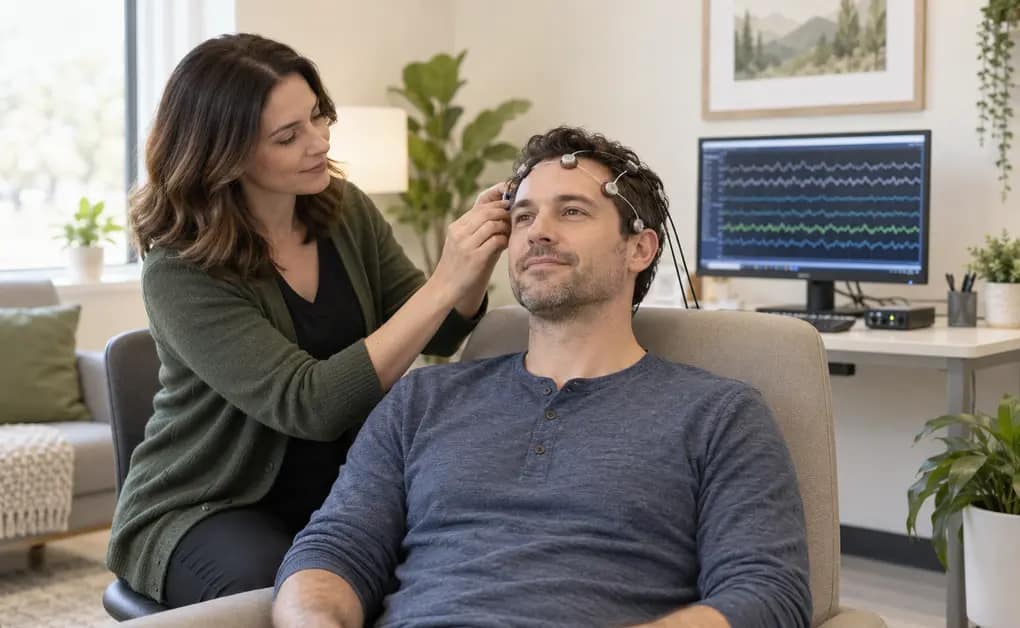
Neurofeedback is a form of biofeedback that provides immediate information about brain activity; during training, participants receive visual or auditory feedback linked to certain EEG patterns.
The aim is to help participants learn to control various aspects of their brain activity; neurofeedback does not include electrical stimulation, and the person stays awake and actively participates throughout the procedure. This distinction is important to emphasize.
Some adults choose neurofeedback because they prefer a drug-free form of treatment or seek an additional option alongside therapy, coaching, or medication management. Although this interest is reasonable, clinicians must present evidence on neurofeedback accurately.
Current Research on Neurofeedback for ADHD
A systematic review and meta-analysis published in JAMA Psychiatry in 2025 examined 38 randomised clinical trials with 2,472 participants; the researchers found no significant overall advantage to neurofeedback for ADHD based on blinded symptom ratings and neuropsychological outcomes.
Although the analysis identified small positive effects in specific areas, including processing speed, in studies using certain established protocols, the authors concluded that current evidence does not support neurofeedback as a stand-alone treatment for ADHD.
Very few studies focus on adults, and researchers cannot directly apply the results from studies of children and adolescents to adults.
The best conclusion is that some adults might view neurofeedback as part of a wider treatment programme that involves monitoring, but it’s important to keep one’s expectations realistic. Assess progress against functional goals and use validated measures rather than relying only on testimonials.
Clinical neurofeedback as opposed to consumer brain-training apps
Consumer apps and games frequently include exercises designed to improve attention, promote relaxation, or provide general cognitive challenges. Yet that does not mean they are the same as EEG neurofeedback provided in a clinical environment.
Clinical care must start with a detailed evaluation of symptoms, diagnoses, treatment history, health considerations, and the patient’s goals. The clinician should explain the proposed training method, how they will assess progress, the expected time commitment, the associated fees, and when to make adjustments or stop the program.
Consumer products, by contrast, generally use standard programmes. These programmes may offer only limited clinical evaluation, professional supervision, or coordination with the patient’s current mental health providers.
Price alone does not determine value. When evaluating a provider, patients should consider qualifications, assessment quality, the reasoning behind the treatment, progress monitoring, and the evidence supporting the proposed method.
Regarding qEEG brain mapping?
A quantitative EEG (qEEG) uses mathematical analysis to compare various aspects of recorded EEG activity, and some neurofeedback providers use qEEG information when preparing treatment protocols.
A qEEG should not serve as a standalone test to confirm an ADHD diagnosis, and it does not guarantee the effectiveness of a neurofeedback protocol.
Providers must refer to their services as “qEEG-guided” only when qualified professionals include brain mapping in their established clinical workflow and interpret it. Patients can ask whether providers use qEEG, why they recommend it, and how it will affect their care.
How to Evaluate a Clinical Neurofeedback Provider
Board certification in neurofeedback offered by the BCIA is a qualification specifically in the field of neurofeedback; the BCIA says that professional certification requires education in either neuroanatomy or neurophysiology, completion of a 36-hour didactic neurofeedback program, 25 hours of mentoring, the review of 100 patient sessions, making case presentations, and passing an examination.
A licence in the healthcare field and certification by the BCIA are two different qualifications; the provider must describe both of them accurately.
When considering a provider, you may want to ask:
- Who will assess my ADHD symptoms and treatment history?
- What neurofeedback-specific training does the provider have?
- Is the person licensed to treat diagnosed mental health conditions?
- What protocol is being recommended, and why?
- How will improvement in daily functioning be measured?
- What happens if my symptoms do not improve?
- Can the provider coordinate with my therapist or prescriber?
- What is the expected total cost?
- Does the provider use qEEG, and how would it affect the treatment plan?
- What are the limitations of the evidence for adults with ADHD?
A trustworthy provider should welcome these questions and avoid guaranteeing results.
Adult ADHD Treatment Options Near Dayton, Minnesota
People who are adults in Dayton and the surrounding Twin Cities areas should not have to make the choice between receiving care that involves only medication and other forms of treatment that do not have support. A full treatment plan could include psychiatric evaluation, the management of medication, therapy, the development of practical skills, and the inclusion of carefully chosen complementary services.
Holsoms provides services to Dayton, Maple Grove, Rogers, Elk River, Champlin, Osseo, and other nearby communities from its clinic at 13691 Balsam Lane North, Suite C, Dayton, MN 55327.
Holsoms provides ADHD assessments and personalised mental health care to teenagers and adults. The website highlights neurofeedback as one of its non-invasive, drug-free services.
Start with an assessment rather than a predetermined treatment plan. Your clinician should help identify which difficulties require attention, which interventions have the strongest support, and how to measure progress.
Frequently Asked Questions
What are the best non-stimulant alternatives for adults who have ADHD?
Other options could be cognitive behavioural therapy that focuses on ADHD, support for executive function, environmental modifications, and in suitable cases, non-stimulant medication. Some adults also look into neurofeedback. The most appropriate option varies by the individual’s diagnosis, symptoms, medical history, other conditions, and why stimulant medication isn’t suitable.
Is it possible to treat adult ADHD without using medication?
A number of adults are able to manage their ADHD without taking medication by means of structured therapy, skills training, coaching, accommodations, and modifications to their environment. In other cases, it can help to combine these measures with medication. The choice should be based on the severity of the symptoms, the degree of functional impairment, personal preferences, and a professional evaluation, not on the idea that one method works universally.
Is neurofeedback effective in cases of adult ADHD?
Evidence concerning adults remains very limited, and a major meta-analysis published in 2025 found no significant overall benefits among people with ADHD. Therefore, clinicians should not recommend it as a standalone treatment. However, some adults might still consider it as part of a more comprehensive treatment programme under clinical supervision and with realistic objectives and structured progress monitoring.
Is neurofeedback identical to a brain-training app?
They aren’t the same. While brain-training apps generally provide standardised games or cognitive exercises, clinical EEG neurofeedback differs because it measures brain activity and provides feedback linked to specific EEG patterns.
Clinical care should also include assessment, a clear protocol rationale, professional supervision, and progress monitoring. Neither of the methods should be offered as a guaranteed treatment for ADHD.
Does Holsoms provide neurofeedback near Maple Grove and Rogers, MN?
Yes, Holsoms provides neurofeedback at its Dayton clinic and serves Maple Grove, Rogers, Elk River, Champlin, Osseo, and nearby communities. Before beginning, patients can discuss their symptoms, previous treatments, and goals with the clinical team to determine whether neurofeedback or another ADHD care option is suitable.
Take the Next Step
If ADHD symptoms are interfering with your work, relationships, or daily responsibilities, you don’t have to navigate alternatives on your own. Schedule a free 15-minute consultation with Holsoms to discuss your symptoms, past treatments, and whether therapy, medication management, neurofeedback, or a coordinated approach may be right for you.
This consultation gives you a chance to ask questions and understand your options. Pursuing this consultation does not commit you to neurofeedback or any other treatment.