Is brain wave training safe? Here’s what Minnesota patients should know before getting started.
It’s natural to wonder if a device that measures brain activity is safe, especially if you or your child might use it. In Minnesota, you may hear some people call it “completely risk-free,” while others give warnings without much explanation.
This guide explains what brain wave training can and can’t do, and what researchers know about its safety. You’ll also learn about possible side effects, when to seek more medical advice, and how to compare clinic-based treatment with home devices.
Is Neurofeedback Safe?
Most people who undergo proper screening can tolerate EEG-based brain wave training well, as long as a qualified professional supervises it. Still, just because a procedure is called ‘noninvasive’ doesn’t mean it can produce side effects.
A 2014 review in the Journal of Neurotherapy noted that researchers had not thoroughly investigated neurofeedback in young people or adults, even though clinical experience suggested that it was reasonably safe.The research literature shows no consistent adverse effects. Please see the study on PubMed.
So, be careful with claims like “neurofeedback has no side effects.” It’s more accurate to say that researchers rarely encounter serious problems, but they should watch for temporary side effects, which can happen.
What do experts consider brain wave training?
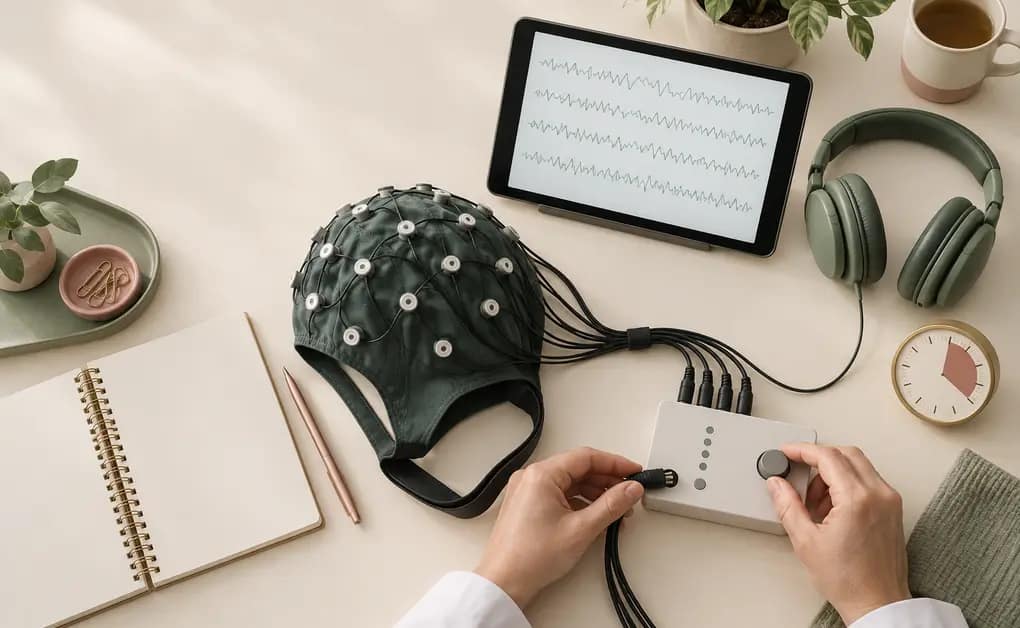
At Holsom, ‘brain wave training’ means EEG neurofeedback. Sensors on your scalp measure the brain’s electrical activity.
Computer programs turn this activity into visual or sound feedback. For example, as your brain activity gets closer to the training goal, the screen might get brighter, a sound might play, or something on the screen might change.
Does neurofeedback involve passing an electric current into the brain?
Standard EEG neurofeedback records your brain’s electrical activity with scalp electrodes and gives feedback. It does not send electrical stimulation into your brain.
It differs from interventions such as transcranial magnetic stimulation, transcranial direct-current stimulation, and other neuromodulation methods that intentionally use magnetic or electrical energy.
You should ask your provider which technology will be used, since ‘brain training’ is a broad term and not all products work the same way.
What does the research indicate about the safety of brain wave training?
Most neurofeedback trials have reported no serious adverse events related to the treatment. For instance, a randomised, sham-controlled study involving adults with ADHD found that there were no serious adverse events either related to the treatment or to the trial itself. The study did not, nevertheless, show a particular clinical benefit of neurofeedback compared with the other conditions. You can read the study in The Lancet Psychiatry.
These findings show that safety and effectiveness should be considered separately. A procedure might feel safe, even if there isn’t enough proof for every use.
The available research also varies substantially by:
- Condition being studied.
- Participant age.
- Training protocol.
- The number of sessions and how often they occur.
- Type of feedback.
- Comparison group.
- The method used to obtain information regarding adverse events.
Instead of relying on general claims about neurofeedback, ask for evidence that relates to your specific situation.
What side effects might result from neurofeedback?
Patients and practitioners may experience temporary changes during or after a session. These may include:
- Headache or pressure sensations.
- Fatigue or mental tiredness.
- Irritability or restlessness.
- Sensing unusually high levels of alertness or stimulation.
- Increased anxiety.
- Difficulty in falling asleep or changes in sleep.
- Dizziness or nausea.
- Temporary difficulty concentrating.
- Emotional sensitivity.
Not everyone gets these effects, and just because a symptom shows up after a session doesn’t mean the training caused it. Things like lack of sleep, caffeine, medication changes, illness, stress, or other health issues could also play a role.
A good provider will track when changes happen, how severe they are, and how long they last. They’ll decide whether to pause training, change the plan, suggest a medical check, or see if it’s safe to continue. When should one do this if symptoms get worse?
Let your provider know right away if you feel worse, instead of waiting for your next appointment. Also, tell your doctor or mental health clinician about any serious or ongoing symptoms.
If you have symptoms like a seizure, fainting, sudden mental changes, new weakness, a severe or quickly worsening headache, thoughts of suicide, signs of mania, chest pain, or trouble breathing, get medical help right away. Don’t assume a serious symptom is just part of the training.
To whom should further medical advice be obtained before starting?
Brain wave training isn’t right for everyone or for every stage of treatment. During your consultation, your provider should consider your medical history, mental health symptoms, diagnoses, medications, sleep habits, substance use, and treatment goals.
Additional coordination may be particularly important for people with:
- A condition involving seizures or episodes of lost awareness that cannot be explained.
- A recent concussion or other brain injury.
- Symptoms which are severe or which change rapidly.
- Or having bipolar disorder or having a previous history of mania.
- A condition of psychosis or a major disruption of contact with reality.
- Having recently thought about committing suicide or about carrying out self-harm.
- Neurological illness.
- Headaches that are severe or have a new pattern.
- Major medication changes.
- An electronic medical device that medical professionals insert into the body.
- A tendency to be sensitive to images that flash or to activities which involve the use of screens.
Being on this list doesn’t mean you can’t get care. It just means your medical history and teamwork among professionals are especially important for safety.
Brain wave training can enhance therapy, medication management, sleep care, occupational therapy, or other services. It should not replace your current treatment.
Don’t stop or change your medication without talking to your prescriber. Changes can affect your sleep, focus, anxiety, mood, and brain activity, making it harder to know what’s causing any changes.
If you have more than one provider, coordinated care can help distinguish normal progress from medication effects, symptom changes, or side effects.
Does a qEEG brain map make neurofeedback safer?
A quantitative EEG, or qEEG, measures and analyses EEG activity and can provide information that a qualified clinician uses alongside symptoms, the patient’s history, observations, and other assessment findings.
A qEEG should not be used alone for diagnosis or as a guarantee that training will be safe or effective. Good interpretation, clean data, reference standards, clinical context, and professional judgment all matter.
Where qEEG information is used, patients should ask:
- Who is in charge of recording and interpreting the data?
- What sort of training leads to that interpretation?
- What effect will the results have on the protocol that has been proposed?
- Will symptoms be recorded alongside the EEG data?
- When will advances and tolerability be reviewed?
Brain wave training guided by a clinician compared with brain wave training using home devices.
Brain training safety involves more than having a sensor. Screening, choosing the right protocol, monitoring symptoms, checking equipment quality, and knowing when to refer for medical help all matter.
| Safety consideration | Clinician-guided brain wave training | Typical consumer home device |
| Initial screening | May include medical, psychiatric and medication history | Often limited to a questionnaire or app setup |
| Training plan | Can be individualized to symptoms and clinical findings | Frequently standardized or selected by the user |
| Signal quality | A trained professional may identify poor sensor contact or artifacts | The user may have limited help interpreting signal problems |
| Monitoring | Symptoms and tolerability can be reviewed between sessions | Monitoring may depend largely on the user |
| Protocol adjustments | Made by the responsible provider based on response | May be automatic or controlled through preset options |
| Care coordination | Can involve a prescriber, therapist or physician when appropriate | Usually separate from the patient’s healthcare team |
| Response to worsening symptoms | Provider can pause training and recommend evaluation | User must decide when and where to seek help |
| Claims and credentials | Patients can verify licenses, education and certifications | Marketing language and oversight vary widely |
Comparing clinics doesn’t mean every clinic is right for you or that all consumer products are unsafe. It shows why you should look at all the services offered, not just the equipment.
What is the impact of FDA regulation on neurofeedback equipment?
A device subject to federal regulation does not mean that it has received approval to treat every condition mentioned in the advertising.
U.S. regulations describe biofeedback devices as instruments that give a visual or auditory signal corresponding to the patient’s physiological state; patients can find the classification language in the Electronic Code of Federal Regulations.
Just because a device has a certain regulatory status doesn’t mean a clinic will use it to treat ADHD, anxiety, PTSD, insomnia, concussion, or other conditions. Ask for the device’s name, what it’s meant for, and the evidence behind the treatment.
Why Provider Qualifications Matter
Brain wave training sits at the junction. Brain wave training combines technology, learning, neuroscience, and clinical care. Having the equipment alone isn’t enough to decide if your symptoms need a new look or if the plan should change. The International Alliance, or BCIA, provides voluntary professional certification in neurofeedback; to obtain it, one must complete education, receive didactic training, participate in mentoring, pass an examination, and meet continuing education requirements. You can learn about the programme’s standards by referring to the BCIA neurofeedback certification programme.
BCIA certifies people, not equipment. Device approval, professional qualifications, and clinical licenses are separate matters that should have clear explanations.
Questions to ask a Minnesota brain wave training provider
Before beginning, ask:
- What qualifications do you have in view of your professional license and of your work in the field of neurofeedback?
- Who is responsible for reviewing and overseeing the care I receive?
- What device and training method will you use?
- Does the equipment record activity, provide stimulation, or do both?
- What does that proposed protocol have that makes it suitable for my objectives?
- What supports the use of it in my specific case?
- What unwanted responses should I watch for?
- What is the method for recording symptoms between sessions?
- What steps should I take if I begin to feel worse?
- Should I get in touch with your therapist, your doctor, or the one who prescribes your medication?
- How often will progress and safety be formally reviewed?
- What costs will arise if the training has to be suspended or given up?
Your provider should answer these questions honestly, without promising a cure or pushing you to buy a big package up front.
How Holsoms Approaches Brain Wave Training Safety in Minnesota
At Holsoms in Dayton, brain wave training is a supervised service, not a stand-alone cure. It starts with a conversation about your concerns, medical history, current care, medications, goals, and any risk factors.
Ronald Omari, who holds a DNP degree and is board certified as an APRN and PMHNP-BC, brings to the clinic’s comprehensive mental wellness services
“We ask our patients to track their sleep, mood, focus, and physical symptoms between visits. If something changes a lot, we check when it happened and decide whether to pause, adjust, or keep going with the program.”
Holsoms provides medical services to the Dayton area and adjacent communities in Minnesota from its clinic at 13691 Balsam Lane North, Suite C, Dayton, MN 55327.
A Practical Safety Checklist Before Your First Session
Before starting brain wave training, confirm that:
- Your healthcare provider has gone over your medical and mental health history.
- You have mentioned the medications you are taking, as well as the recent changes to your medication.
- You understand how the sensors and equipment work.
- You are aware of the objectives and limitations of the proposed service.
- You know about the possible benefits and risks.
- You know that the symptoms will be monitored.
- If you feel worse, you should call them.
- Your provider has made clear when another clinician should be involved.
- You know about the time and money involved.
- No one has promised a cure or guaranteed a result.
Good care means you can ask questions, give informed consent, have regular check-ins, and know that training might not always be the best choice.
F. Frequently Asked Questions
Is neurofeedback safe in the case of most people?
EEEEG neurofeedback is usually called noninvasive and is generally well tolerated, according to studies. Still, research hasn’t always tracked side effects, and things like headaches, tiredness, irritability, anxiety, trouble focusing, or sleep problems can happen. Screening and ongoing monitoring are important. Does electricity get introduced into the brain as a result of brain wave training?
Standard EEG brain wave training uses sensors on your scalp to record brain activity and turn it into feedback. The sensors don’t send electricity into your brain. Check which device and method are being used, since some ‘brain training’ services use different technology.
Is neurofeedback safe for children?
Some studies have included children, especially those with attention issues. To keep kids safe, providers should use age-appropriate screening, equipment, and protocols, communicate clearly, and provide good supervision. Parents should ask about the provider’s experience with children, possible side effects, how progress is tracked, and how the service works with the child’s doctor or mental health provider. Yes, may I take my medication while I am doing brain wave training?
Brain wave training can sometimes be done along with medication, but don’t stop or change your prescription without talking to your prescriber first. Tell your provider about all your medications and any recent changes, since these can affect your symptoms, sleep, alertness, and progress.
Where can I talk about the safety of brain wave training in Minnesota?
The Dayton, Minnesota clinic offers brain wave training consultations. In a consultation, you can review your goals, medical history, current treatment, and any safety concerns. This doesn’t guarantee that training will be recommended—sometimes, more evaluation or talking with your current clinician is better.
Call to Action
Go Over Your Safety Questions Before Starting Training
Arrange a free 15-minute consultation with Holsoms to talk about your objectivBook a free 15-minute consultation with Holsoms to talk about your goals, current care, health history, and see if a full brain wave training assessment is right for you.