When comparing clinical neurofeedback with a home device, you might ask whether the extra cost and travel time are justified by professional supervision. You might also wonder whether home headsets can provide the same level of brain wave training.
The answer depends on the product, your objectives, and whether you have clinical symptoms that need professional attention. This guide covers the technology, personalisation, convenience, safety, available evidence, and costs associated with both options. It also explains how to assess a neurofeedback clinic in Dayton or nearby communities in Minnesota.
What Is Clinical Neurofeedback?
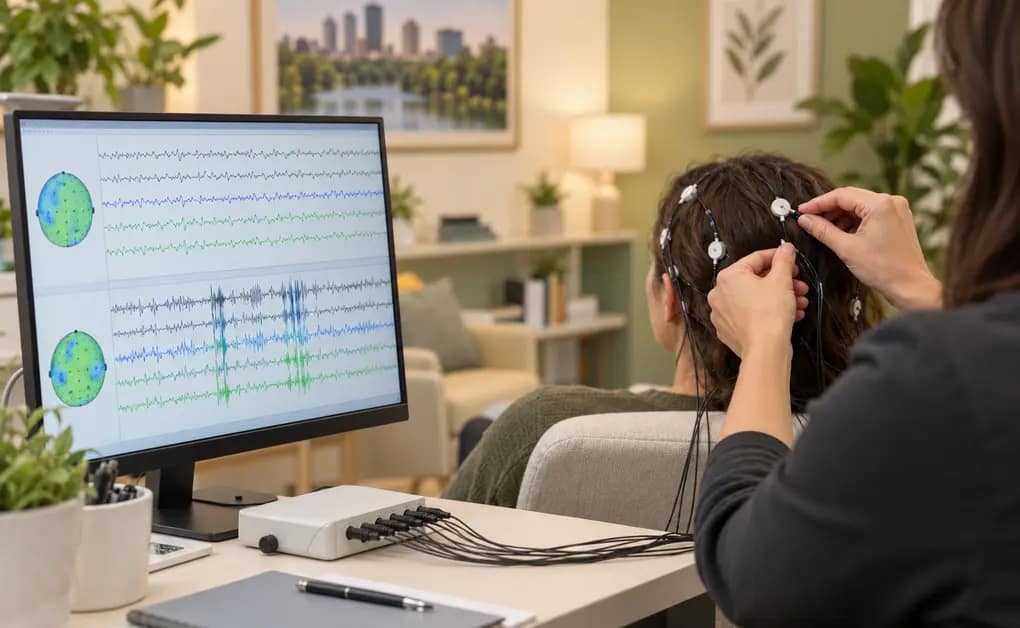
Clinical neurofeedback is a form of biofeedback that uses EEG sensors to record electrical activity from the scalp, and specialised software turns certain features of this activity into immediate visual or auditory feedback.
At Holsoms, this service is called clinician-guided brain wave training, with the word “training” highlighting that it involves learning and preventing any suggestion that the equipment can diagnose, cure, or treat a disorder on its own.
A professional service may include the following:
- A review of the relevant history together with an intake
- A talk about the symptoms, the objectives, and the present course of treatment
- EEG sensor placement and checking signal quality
- The choice of suitable training parameters
- Monitoring during sessions
- An overview of the progress and possible side effects
- When needed, coordination with other clinicians
The specific procedure can differ from one provider to another, so patients should inquire about what is included rather than assume that all clinics follow the same method.
What Counts as an At-Home Brain-Training Device?
The term “at-home brain-training device” covers a wide variety of products that work in different ways.
Most brain-training applications make use of puzzles, memory exercises, meditation sessions, or attention games. Although they may assist with practice or relaxation, most do not record EEG activity and therefore do not qualify as neurofeedback.
Consumer EEG Wearables
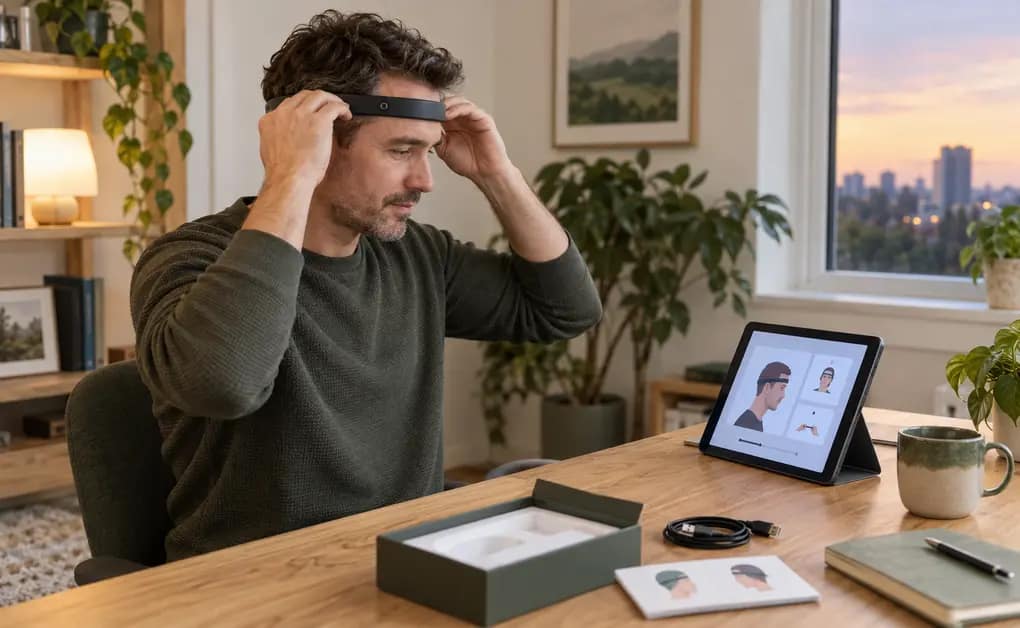
Consumer EEG devices use one or more sensors to pick up brain activity and give users feedback through sounds, games, meditation exercises, or performance scores.
The number and placement of sensors, the signal-processing techniques used, and the intended purposes differ from device to device. Do not treat consumer EEG wearables as equivalent to professional neurofeedback systems.
Self-Directed Home Neurofeedback Systems
Some products offer EEG-based feedback that users can utilise without regular professional involvement. In these systems, users select programs, manage the equipment, and interpret their own progress.
This option may appeal to those seeking convenience or general wellness training. However, it may not suit individuals with complex, rapidly changing symptoms or symptoms linked to a diagnosed medical or psychological condition.
Professionally Supervised Remote Neurofeedback
Some home-based programs are run with the supervision of a remote professional. The provider can conduct an initial evaluation, choose the training settings, review the uploaded data, and adjust the program as needed.
This method differs from consumer applications that work without supervision because it balances convenience with professional monitoring, though the extent and quality of involvement can vary widely.
Clinical Neurofeedback vs. Home Device: The Main Differences
| Comparison area | Clinician-guided brain wave training | At-home brain-training device |
| Initial screening | Usually includes a professional intake | May range from none to a remote questionnaire or consultation |
| EEG measurement | Uses professional equipment and supervised sensor placement | Varies by product, sensor number, and design |
| Signal-quality checks | Provider can identify poor contact, movement, and electrical interference | User may rely on automated alerts or instructions |
| Training selection | May be individualised within the provider’s approach | Often uses preset programs, although supervised systems may be customised |
| Monitoring | Direct observation and progress review | Ranges from self-monitoring to remote professional review |
| Clinical coordination | May involve communication with existing providers | Often separate from healthcare unless professionally supervised |
| Convenience | Requires scheduled appointments and travel | Can usually be completed at home |
| Cost | Often higher per appointment | May involve a device, subscription, rental, or remote-supervision fee |
| Privacy | Governed by the clinic’s healthcare and data practices | Depends on the manufacturer, app, and third-party services |
| Appropriate use | May be considered when symptoms require clinical oversight | Often positioned for wellness, meditation, or performance goals |
| Technical support | Provider manages most setup and troubleshooting | User may be responsible for placement, connection, and maintenance |
| Emergency support | Clinic can explain its escalation and referral procedures | A consumer app is not an emergency or crisis service |
These differences are general; specific services and products may not fit neatly into either category.
Why Professional Assessment Matters
Symptoms like difficulty concentrating, poor sleep, restlessness, low motivation, and emotional distress can stem from various causes.
For instance, concentration issues may relate to ADHD, anxiety, depression, sleep deprivation, medication effects, substance use, hormonal changes, or underlying physical health conditions. Device feedback cannot replace a thorough professional assessment.
Professional screening can help determine:
- Whether it is necessary to carry out further evaluation
- Whether current symptoms need urgent attention from a healthcare provider
- The effect of medication or other treatments on the changes
- Whether it is suitable to investigate brain wave training
- What goals are both realistic and measurable
- When a further professional should be brought in
An individual’s self-assessed score should not be used for the diagnosis of a mental health or neurological disorder.
How Signal Quality Differs
The EEG signals obtained from the scalp are generally weak. Muscle tension, blinking, jaw movements, sensor contact, nearby electronics, and body movement can interfere with these recordings. These factors can create “artefacts,” which may look like brain activity if not correctly identified.
In clinical situations, providers can:
- Check sensor contact
- Note movements of the body and face
- Reposition sensors
- Review unusual signal changes
- Halt the training if the signal is unreliable
- Document recurring technical issues
Home systems can include automated tools to assess signal quality, but the results may differ. It is advisable to find out how the system detects artefacts and whether a qualified person examines the data.
More sensors do not automatically mean better results. Placement, recording, interpretation, and training design are just as important.
Are Clinical Protocols More Personal?
Clinical services could enable providers to adjust training parameters based on the participant’s objectives, responses, and relevant assessment information.
Yet the term “personalised” is frequently used loosely in marketing. A questionnaire that assigns each user to one of three preset programmes is not equivalent to continuous individualised clinical decision-making.
Questions to Ask Your Provider
- What information is used to draw up the first training plan?
- Which sections of the plan can be adjusted?
- Who is entitled to make those adjustments?
- How often is progress reviewed?
- What situations could cause the provider to alter or discontinue training?
Holsoms should not promote its qEEG-guided protocols until the clinic has confirmed who provides the qEEG, who interprets it, and how this information influences the training.
What Does the Research Have to Say Regarding Home Neurofeedback?
Research into remote and app-supported neurofeedback is still developing. A 2022 retrospective study published in JMIR Formative Research reported symptom improvements among users completing therapist-guided remote neurofeedback.
However, this study analysed real-world data retrospectively and did not use a randomised control group, meaning its findings are preliminary. They do not establish that neurofeedback itself caused the reported improvements, nor can they guarantee the same results with every device or user.
Findings from one supervised platform cannot be generalised to:
- Every EEG headset
- Unsupervised home training
- Non-EEG brain games
- Meditation apps
- Products using different feedback methods
- Devices promoted for various symptoms
The 2020 CRED-nf consensus published in Brain emphasises rigorous controls, clearly defined feedback signals, measurement of learning, clinically meaningful outcomes, and reporting of adverse effects. These standards are essential when evaluating claims about both clinical and home systems.
Is There Stronger Evidence for Clinical Neurofeedback?
The term “clinical” does not, by itself, mean it has been proven scientifically. The evidence regarding neurofeedback is based on a number of factors:
- The condition or goal being studied
- The neurofeedback method
- The training protocol
- The quality of the comparison group
- Whether outcome assessors were blinded
- Whether participants learned to regulate the target signal
- Whether improvements were meaningful in daily life
- Whether effects continued after training
Some neurofeedback studies show promising outcomes, while others report only small, inconsistent, or nonspecific effects.
Instead of depending on general neurofeedback research to guarantee results from a different device, protocol, or group, a responsible clinic should explain the evidence supporting the proposed use and also describe its limitations.
Is It Safe to Use an At-Home Neurofeedback Device?
A noninvasive device can also be used inappropriately, and safety relies on the product, the user, the training method, and the claims.
Possible concerns include:
- Temporary fatigue or headache
- Irritability or restlessness
- Changes in sleep
- Difficulty concentrating
- Incorrect sensor placement
- Training based on unreliable signals
- Misinterpreting wellness scores as medical findings
- Delaying appropriate clinical care
- Changing medication without professional guidance
- Privacy or cybersecurity concerns
If you have serious psychiatric symptoms, a neurological disorder, a history of seizures, have recently suffered a head injury, are experiencing rapidly changing symptoms, or have complex medication requirements, it is important to get professional advice before using a home device.
Do not use a home device as a replacement for emergency care. You should seek immediate assistance if you have suicidal thoughts, serious changes in behaviour, seizures, sudden neurological symptoms, or any other urgent health concerns.
What Does the FDA Status Mean for Neurofeedback Devices?
The FDA has classified biofeedback devices as Class II under 21 CFR §882.5050 and lists EEG neurofeedback systems in the biofeedback category in its product classification database.
Nevertheless, regulating these devices goes beyond simply saying they are “FDA registered” or “FDA approved.”
Important distinctions include:
- A company or facility has fulfilled the administrative registration requirement
- There is a device listed in the FDA listing system
- The device belongs to a regulatory category
- The FDA has found that the device is substantially equivalent to a predicate device that was legally marketed for the intended use specified
- This pathway is usually linked with devices that pose a higher risk
The fact that a product is classified as Class II does not mean that all home headsets are approved by the FDA for the treatment of ADHD, anxiety, PTSD, depression, or other disorders.
Ask the manufacturer for the product code, intended use, and regulatory documentation, then check these details in the FDA database rather than relying on marketing claims.
Why Provider Qualifications Matter
The Biofeedback Certification International Alliance offers a professionally recognised pathway for certification in the field of neurofeedback, and its requirements for entry-level certification include:
- Relevant education
- A separate course in neuroanatomy, neurophysiology, or physiological psychology
- A neurofeedback didactic course that has been approved for a duration of 36 hours
- Twenty-five mentoring contact hours
- A review of 100 client or patient sessions
- Ten case-study presentations
- A certification examination
Is a Home Device Cheaper?
Home devices may seem cheaper because they eliminate the need for frequent clinic visits. However, you should compare the total cost rather than the advertised purchase price.
Potential Home Costs Include
- Device purchase or rental
- Monthly software subscriptions
- Replacement sensors or supplies
- Initial assessment
- Remote professional supervision
- Technical support
- Minimum subscription periods
- Return or restocking fees
Potential Clinical Costs Include
- Intake and assessment
- Individual sessions
- Progress reviews
- Optional testing
- Coordination with other providers
- Missed-appointment charges
A lower price is worthwhile only if the product suits your goals, provides useful feedback, and doesn’t delay necessary care.
Request a full written estimate before buying either option.
What About Privacy and Personal Brain Data?
Home EEG products can gather sensitive information through the device, the app, or the cloud platform.
Before purchasing, review:
- The data collected, including both physiological and personal data
- Whether raw EEG information is stored
- The location where the data are stored
- Whether information is used to improve algorithms
- Whether the company shares its data with advertisers or other third parties
- The duration for which records are kept
- Whether you can download or delete your data
- What would occur if the company were sold or closed
It would be wrong to suppose that a wellness app is protected by HIPAA. Consumer technology companies may follow privacy rules different from those that apply to healthcare providers.
Clinical services should also clarify how they handle privacy, record keeping, and electronic communication.
What Kind of Person Would Prefer to Have a Device at Home?
A home option may appeal to someone who:
- Has general meditation, relaxation, or performance goals
- Values convenience
- Understands the device’s limitations
- Can consistently follow the setup instructions
- Can access reliable technical support
- Does not require a clinical assessment or medical coordination
- Selects a remote program that is professionally supervised
This does not mean that a home device is suitable for every wellness objective or symptom.
Who May Benefit From On-Site Supervision?
A clinician-guided option may be more appropriate to explore when someone:
- Has a diagnosed mental or brain condition
- Is taking medication that could have an effect on attention, sleep, or EEG activity
- Has symptoms that are complex or change quickly
- Has previously responded adversely to training
- Has difficulty telling the symptoms apart from other health issues
- Wishes to arrange coordination with a therapist, prescriber, or physician
- Finds it unpleasant to manage the sensors and technology alone
- Wants direct monitoring and specific documented review points
Professional oversight alone does not guarantee improvement. Its value consists of providing screening, ensuring accountability, offering technical support, and being involved in clinical decision-making.
Might Remote Professional Supervision Be an Intermediate Choice?
Yes, some systems allow training at home, with a professional reviewing the data and making remote adjustments to the plan.
When evaluating remote programs, ask the following questions:
- Who carries out the first screening?
- Is the supervisor required to have a Minnesota licence?
- Does the supervisor have a verified neurofeedback qualification?
- How frequently is the data reviewed?
- Are the sessions monitored live, or are they reviewed afterwards?
- What should I do if symptoms get worse?
- What is the method of identifying technical artefacts?
- Has the equipment been bought, hired, or given back?
- What are the total costs?
- What measures are in place to protect personal data?
What Takes Place in Clinician-Guided Brain Wave Training?
A typical appointment includes sensor preparation, a signal-quality check, an active feedback phase, and a brief discussion of the participant’s response.
The feedback can be given in different forms, such as:
- A video that becomes clearer or dimmer
- Music that changes in volume
- A tone that plays
- An animation that responds
- A game element that moves
The sensors pick up brain activity; they do not transmit electricity into the brain.
At Holsoms Mental Wellness Clinic, in our practice we start off by explaining what the sensors record, checking to see that the participant is comfortable and looking over any changes that have been noticed since the last session, and also make it clear to the participants that they do not need to force the screen to react.
How to Choose a Neurofeedback Clinic Near Me
When assessing a local provider, go beyond the equipment brand and the statements made on the website.
Ask yourself the following questions:
- Who provides the training and monitors it?
- What qualified degrees and credentials specific to neurofeedback do they have?
- Is it possible to verify those qualifications as current and independently?
- What does the intake process use to decide if training is suitable?
- What process is used for choosing the training parameters?
- What method is used to check the quality of an EEG signal?
- How are goals and progress measured?
- When will the plan undergo a formal review?
- Will the provider coordinate with existing clinicians?
- What would occur if the training was not effective?
- Is there a record of the device’s regulatory status?
- What measures are in place to protect personal information?
Do not choose providers who promise cures, tell you to stop receiving current care, are unwilling to explain their qualifications, or pressure you into a large prepaid package.
Clinician-Guided Brain Wave Training Near Dayton, Minnesota
Holsoms serves Dayton and nearby communities from its clinic located at:
Holsoms TMS Mental Wellness Clinic
13691 Balsam Lane North, Suite C
Dayton, MN 55327
The clinic supports patients from Dayton, Maple Grove, Rogers, Champlin, Osseo, Elk River, and surrounding Twin Cities communities.
If you are searching for a “neurofeedback clinic near me,” you can schedule an introductory conversation to inquire about current availability, professional oversight, training procedures, fees, and how the service may fit alongside your existing care.
Frequently Asked Questions
1. Is a home-based neurofeedback device as effective as clinical neurofeedback?
We cannot conclude that each home device is as effective as clinician-guided training because products use different sensors, software, and feedback methods.
Some remote systems include professional supervision, while others are entirely self-directed. Evidence from one device or procedure does not apply to all products.
2. Is it possible to have neurofeedback at home without the aid of a professional?
Some consumer products allow for independent home use. Whether this is appropriate depends on the device, your goals, health history, and symptoms.
Individuals with diagnosed conditions, significant symptoms, neurological concerns, or complex medications should consult a qualified professional before relying on self-directed brain wave training.
3. Are at-home brain-training devices FDA approved?
Not necessarily. Registration, listing, Class II classification, clearance, and approval have different meanings.
Some biofeedback devices fall under FDA Class II regulations, but that does not mean every consumer headset is approved to treat a medical condition. Verify the specific product, its intended use, and regulatory documentation.
4. Why does clinical neurofeedback cost more than a home device?
Clinical fees may include professional intake, supervised sensor placement, signal-quality checks, individualised decisions, progress monitoring, documentation, and coordination with other providers.
A home device may only involve the cost of equipment and software. Higher cost does not guarantee better results, so ask for a clear explanation of what is included.
5. What neurofeedback clinic is there near Dayton, MN?
Holsoms TMS Mental Wellness Clinic in Dayton is at 13691 Balsam Lane North, Suite C, Dayton, Minnesota, and serves Dayton, Maple Grove, Rogers, and the surrounding areas.
Individuals can get a free initial consultation to learn about availability, costs, the level of professional supervision, and whether brain wave training fits their needs.
References
- Biofeedback Certification International Alliance. “Neurofeedback Entry-Level Certification.”
- U.S. Food and Drug Administration. “Biofeedback Device—Product Classification.”
- Electronic Code of Federal Regulations. 21 CFR §882.5050, “Biofeedback Device.”
- Ros T, Enriquez-Geppert S, Zotev V, et al. “Consensus on the Reporting and Experimental Design of Clinical and Cognitive-Behavioural Neurofeedback Studies.” Brain. 2020.
- Shereena EA, et al. “Preliminary Real-World Evidence Supporting the Efficacy of a Therapist-Guided Remote Neurofeedback Intervention.” JMIR Formative Research. 2022.
- Holsoms TMS Mental Wellness Clinic. Official website.